In 1530, a fissure opened in the bedrock of global civilization. Over the next five years, that crack didn’t heal; it accelerated toward a total rupture.
Welcome to 1535 Turning Point in History
In this year, the era of testing the waters, hesitating, and seeking middle ground vanished. Conscience was sent to the guillotine, religious frenzy was locked in iron cages, and the map of globalization was being redrawn in blood and soot.
Catalogue
The Sound of the Ax in London
In the summer of 1535, the air in the Tower of London was thick and heavy.
Thomas Cromwell, Henry VIII’s Chief Minister, was using the cold efficiency of a modern bureaucrat to purge the remnants of the old world. Standing in his way was a “moral mountain”: Sir Thomas More.
Who was More?
The author of Utopia, the most prestigious humanist scholar in Europe, and the former Lord Chancellor of England. More hadn’t actually “done” much; he simply chose silence in the face of the Act of Supremacy (the 1534 law that effectively nationalized God’s authority and made the King the “Supreme Head” of the Church). More hoped that “silence implies consent,” but in the England of 1535, silence was rebranded as high treason.
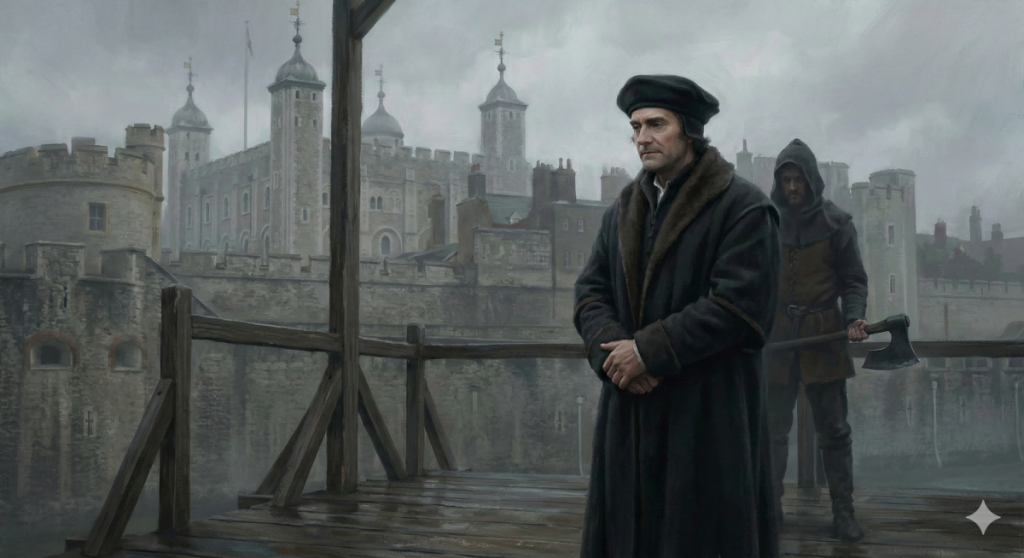
On July 6, More was led to the block. Before the ax fell, he uttered a final line that has echoed for five centuries:
“I die the King’s good servant, but God’s first.”
A few weeks earlier, Bishop John Fisher had already “set the trend”. Pope Paul III, thinking the King wouldn’t dare execute a Cardinal, sent Fisher a Cardinal’s red hat. Henry VIII simply sneered: “The Pope may send him a hat, but I will send the head to Rome to fit it.” Both heads ended up on pikes atop London Bridge.
Yet, in the same year the axes fell, a different kind of power was rising. On October 4, 1535, the first complete modern English Bible—the Coverdale Bible—was printed in Antwerp. It was a revolutionary weapon, scattering the seeds of independent thought among the common people and laying the groundwork for the future Puritan Revolution.
Henry VIII used the ax to tell the world: On this land, the King is God. And the Coverdale Bible used the printed word to tell the world: The Bishops are not the only ones who speak for God.
The Cages of Münster
While England showcased state tyranny, Germany was showcasing religious mania. In the city of Münster, a social experiment known as the “New Jerusalem” reached its bloody finale.
In 1534, a tailor named Jan of Leiden declared himself the “successor of King David” and led a group of radical Anabaptists to seize the city. They expelled Catholics and Lutherans alike, burned every book except the Bible, abolished private property, and enforced a terrifying communal regime.
By 1535, this “Heaven on Earth” had turned into a literal hell. Starving citizens ate leather, grass, and eventually, corpses. Meanwhile, Jan of Leiden wore magnificent robes and took 16 wives during the height of the famine.
In a twist of irony, the exiled Bishop Franz von Waldeck united Catholic and Lutheran armies—bitter enemies joining forces to crush this “extremist heresy”. On June 24, 1535, Münster fell. The resulting slaughter was indiscriminate; the “Kingdom of Heaven” on earth drowned in a religious bloodbath.
Jan and his lieutenants were captured. The following year, they were tortured with red-hot pincers for an hour before being stabbed through the heart. Their bodies were placed in iron cages and hung from the steeple of St. Lambert’s Church. The bones are long gone, but those three cages remain there today.
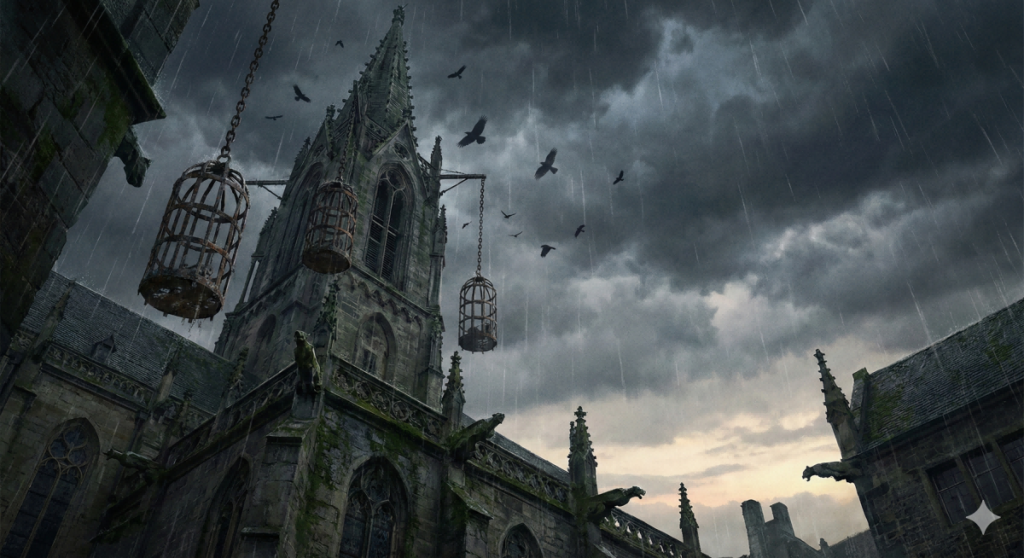
They serve as 1535’s grimmest warning:
When faith loses its anchor in reason, the line between heaven and hell disappears.
The Emperor’s Tapestries and a Mother’s Silver Coins
While Northern Europe struggled in a theological swamp, Charles V, Holy Roman Emperor, was looking south.
In 1534, the Ottoman Admiral Barbarossa (Redbeard) captured Tunis, putting an Ottoman blade to the throat of Europe.
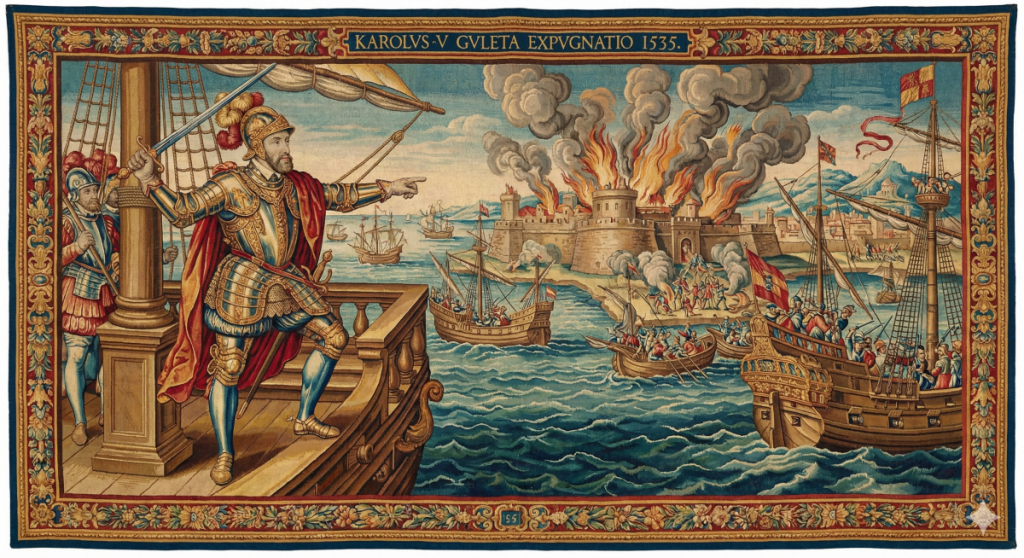
Charles V launched a “Crusade” in response. In the summer of 1535, he led 30,000 soldiers and 300 ships to Tunis. The victory was spectacular: his forces took the fortress of La Goletta, routed Barbarossa, and “liberated” 20,000 Christian slaves.
Charles V portrayed himself as the savior of Christendom, even commissioning grand tapestries to depict the battle as a Roman-style triumph. But the truth was grittier than the weaving. His mercenaries sacked Tunis, massacring 30,000 Muslim civilians over three days. Furthermore, the wily Barbarossa had slipped away with his fleet before the trap closed, raiding the Balearic Islands the very next year. The Tunis campaign was a tactical masterpiece but a strategic stalemate.
Meanwhile, in the Kremlin, five-year-old Ivan the Terrible sat on the throne, but the real power was his mother, Elena Glinskaya.
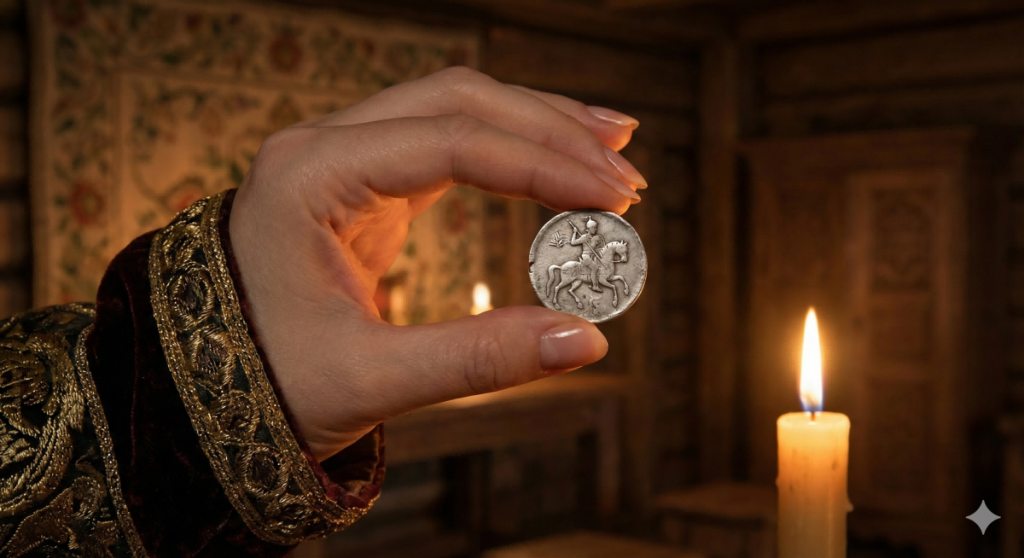
History often overlooks her, but on March 20, 1535, she was sewing the nation together with something more practical than an ax: currency.
Russia was plagued by counterfeit coins and chaotic exchange rates. Elena banned old coins and established a state mint to issue a standardized silver coin.
This new coin featured a rider with a spear (kopya), leading people to call it the Kopek. While the men of Europe were fighting over God with fire and steel, this woman was quietly building the economic skeleton of a future superpower
Building, Survival and a “Rain of Stones”
Across the Atlantic, a new set of rules was being written in the “New World”.
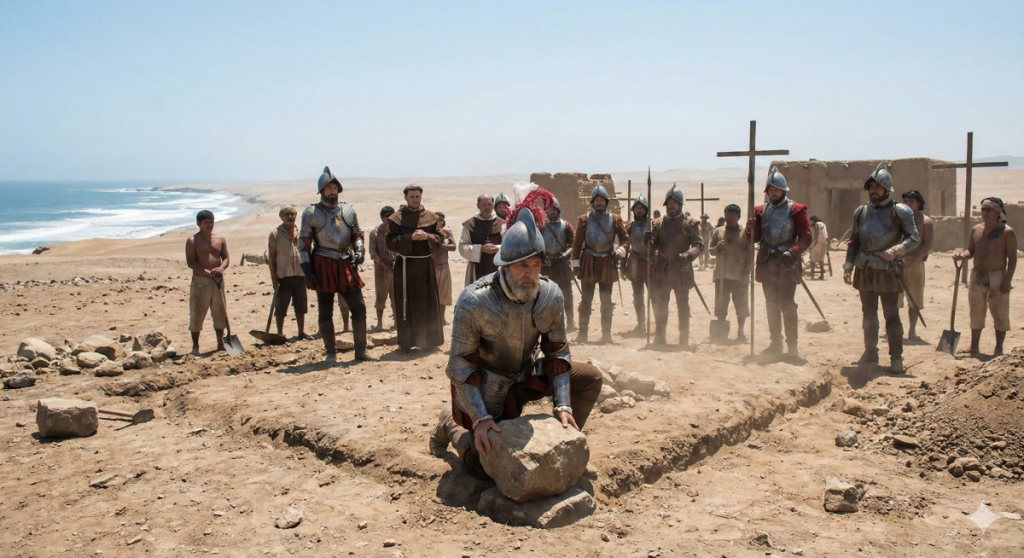
On January 18, 1535, Francisco Pizarro—the man who toppled the Inca Empire with just 180 desperados—founded a new capital. He called it the “City of the Kings,” but it became known as Lima. Pizarro chose the coast over the high-altitude Inca capital of Cusco so he could more easily ship looted silver back to Spain. As he laid the first stone of the Lima Cathedral, Spanish colonial rule officially took root.
However, the embers of resistance were glowing. Manco Inca, the puppet ruler Pizarro had installed, had endured unspeakable humiliations—including having Pizarro’s brothers assault his wife and urinate on him. He was biding his time, playing a long game of revenge. The following year, he would nearly drive the Spanish into the sea during the Siege of Cusco.
To the north, French explorer Jacques Cartier was battling a different enemy: the Canadian winter. In 1535, he sailed up the St. Lawrence River, reaching present-day Quebec City and Montreal. He named a high point “Mont Royal” (Mount Royal), but his quest for a route to China was cut short by ice.

His crew was decimated by scurvy. Their gums rotted, their teeth fell out, and their legs turned black. They were saved only when the local Iroquois shared a secret: a tea made from the “Annedda” tree (likely white cedar). This “Life Water” rich in Vitamin C saved the expedition. It was a rare moment of human cooperation, though it didn’t stop Cartier from later kidnapping the chief, who died in France.
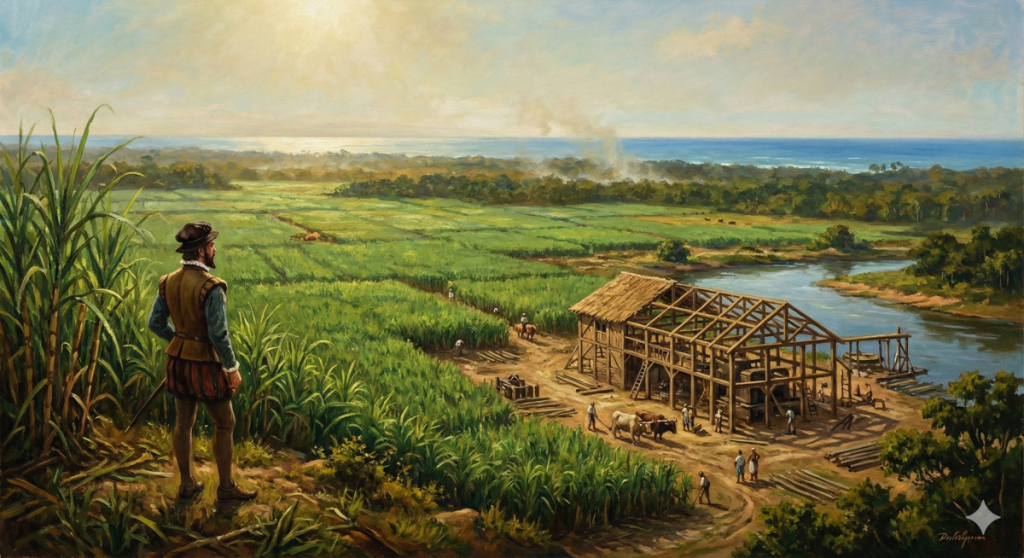
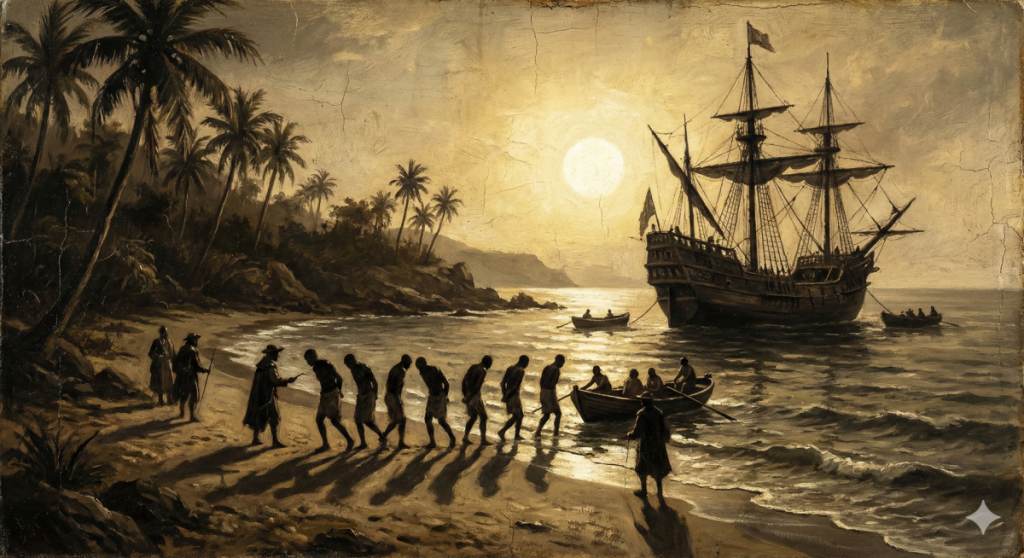
In Brazil, the Portuguese were “privatizing” colonization. King John III divided the coast into hereditary captaincies, letting nobles develop the land on their own dime. In March 1535, Duarte Coelho arrived in Pernambuco and struck “white gold”—sugar. But this wealth required a massive labor force, leading to the beginning of a “black river” of enslaved Africans being shipped to the plantations.
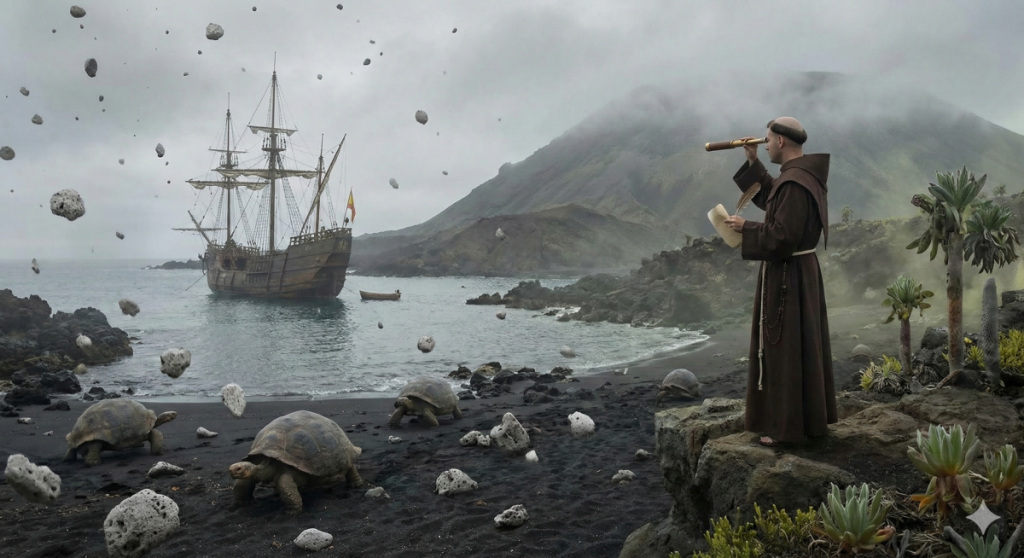
Lastly, a literal “wrong turn” changed science forever. On March 10, 1535, Fray Tomás de Berlanga, the Bishop of Panama, was sailing to Peru when his ship was becalmed and drifted off course. He stumbled upon a cluster of desolate volcanic islands. He hated them, describing the land as so barren it looked like “God had rained stones”. To vent his frustration, he took notes on the “stupid” birds, “devil-like” lizards, and giant tortoises (Galápagos).
He didn’t know it, but his disgruntled travel log would become the “Eden” where Charles Darwin would later solve the mystery of the origin of species.
Cracks in the East: A Single Blade and a Broken System
The Mughal Spike in India
In India, at the fortress of Champaner, the air was thick with the shadows of night. Humayun, the second emperor of the Mughal Empire, led from the front. He and 300 warriors scaled a vertical cliff by driving iron spikes into the stone walls, launching a surprise assault that snatched this formidable stronghold from the hands of the Gujarat Sultan, Bahadur Shah.
Humayun didn’t stop there. In a subsequent field battle near Mandu, he crushed the Sultan’s forces—despite their powerful Ottoman-backed artillery—and completely conquered the wealthy regions of Gujarat and Malwa. At that moment, the Mughal borders had been pushed to a new extreme.
However, victory came fast and vanished even faster. Instead of establishing a functioning administration to hold his prize, Humayun spiraled into a haze of opium and celebration. Within a single year, the territory was lost. Yet, his brief invasion inadvertently triggered a domino effect that would nail the Portuguese firmly to the Indian coast for centuries.
Though Bahadur Shah later tried to double-back and reclaim Diu (a move that got him killed by the Portuguese in 1537), he failed. This military structure became an iron nail driven into the crown of the Portuguese “Maritime Empire,” laying the foundation for European naval hegemony in the Indian Ocean for hundreds of years.
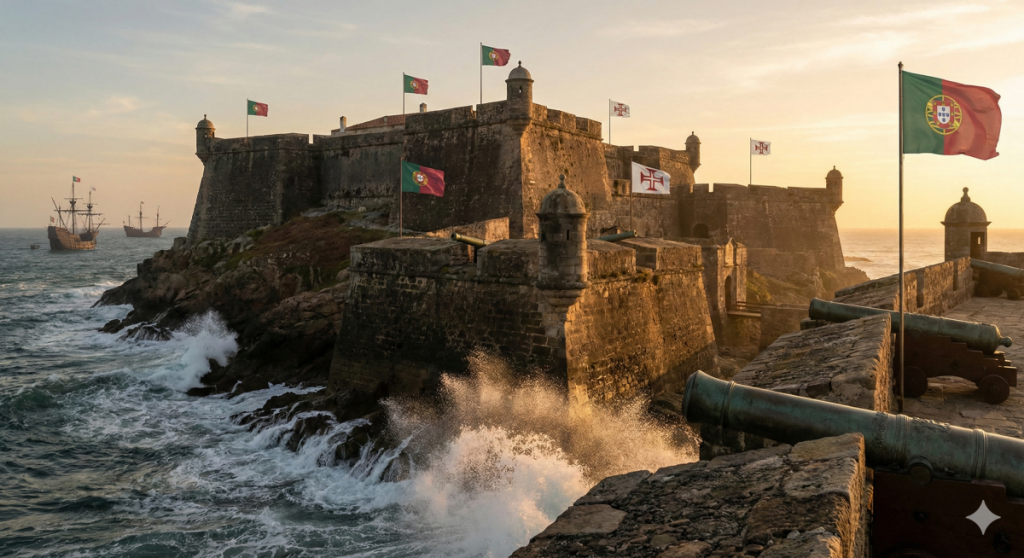
It is a fascinating study in historical chain reactions: Humayun’s conquest forced the hand of a desperate Sultan; the desperate Sultan invited in the Portuguese; the Portuguese seized the opening to drive home their stake—and that stake changed the fate of the entire Indian Ocean.
Internal Decay in the Ming Empire
While the Indian subcontinent was locked in imperial chess, East Asia was facing its own crises—one rotting from within, and the other decided by a freak stroke of a blade.
The Jiajing Emperor of the Great Ming Empire was entering the fourteenth year of his reign. That year, a mutiny broke out on the empire’s northeastern frontier, sending shockwaves through the imperial court.
A year prior, Lü Jing, the newly appointed Right Assistant Censor-in-Chief, arrived to inspect Liaodong. To show off his “efficiency,” he slashed two-thirds of the military support staff and forced the remaining soldiers into grueling labor to repair the border walls. His demands for speed and quality were nothing short of tyrannical.
When the soldiers pleaded for a reprieve from the back-breaking labor, Lü Jing didn’t just turn a deaf ear—he ordered his henchmen to beat the messengers. This was the final straw. The Garrison soldiers, fueled by righteous fury, revolted.
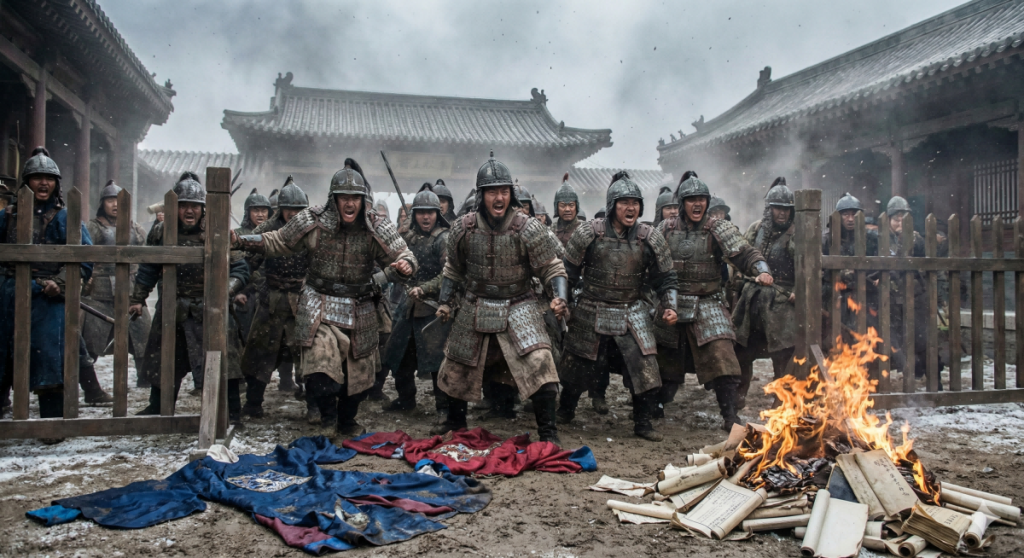
The mutineers stormed the government offices, burned the labor records, and literally tore the official robes off Lü Jing’s back. They threw him, naked and humiliated, into prison and coerced other officials into reporting eleven “crimes” committed by Lü to the capital. As a result, the Jiajing Emperor stripped Lü Jing of his post and threw him in jail.
The mutiny was eventually quelled, but the damage was done. It exposed the total collapse of the Ming “Weisuo” (garrison) system. Soldiers had become little more than serfs for their commanders; the border defenses were hollow shells, and morale had evaporated. This “muscle spasm” on the frontier laid the groundwork for the future “Wokou” pirate raids and the eventual Manchu crisis a century later.
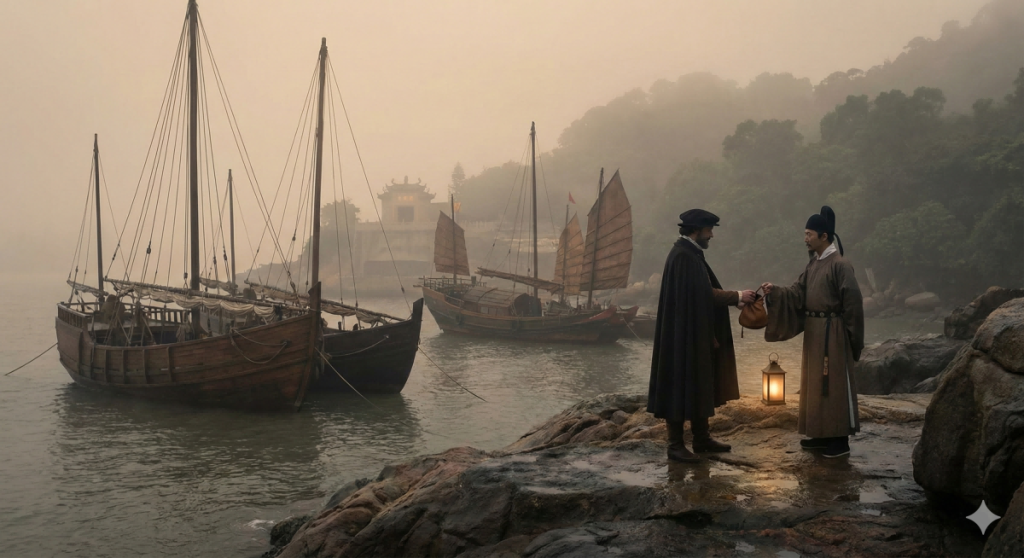
An empire’s crisis usually starts at the edges, but the ruler at the center is often the last one to hear the sound of the foundation cracking.
The “Moriyama Collapse” in Japan
Across the sea in Japan, an event known as the “Moriyama Collapse” completely rewrote the timeline of Japanese unification.
Matsudaira Kiyoyasu, the young head of the Matsudaira clan and grandfather of the future Tokugawa Ieyasu, was a rising star. At just 24 years old, he had already unified Mikawa Province and was hailed as the brilliant leader most likely to end the chaotic “Warring States” period.
In 1535, he was leading his forces to invade Owari Province (the territory of the Oda clan). However, while camping at Moriyama, a baseless rumor triggered a tragedy. One of his own retainers, Abe Masatoyo, snapped under the stress of the rumor and cut Kiyoyasu down with a Muramasa blade.
With Kiyoyasu dead, his son Matsudaira Hirotada was driven out of their home castle, and the clan’s power disintegrated overnight. This freak accident didn’t just save the vulnerable Oda clan from certain destruction; it turned the once-proud Matsudaira family into a mere vassal of the Oda.
Consider the “what if”: had Kiyoyasu lived past 1535, the world might never have known Oda Nobunaga. Without that tragedy, Tokugawa Ieyasu would never have been sent away as a hostage—a hardship that forged the legendary patience and stoicism that eventually allowed him to rule Japan.
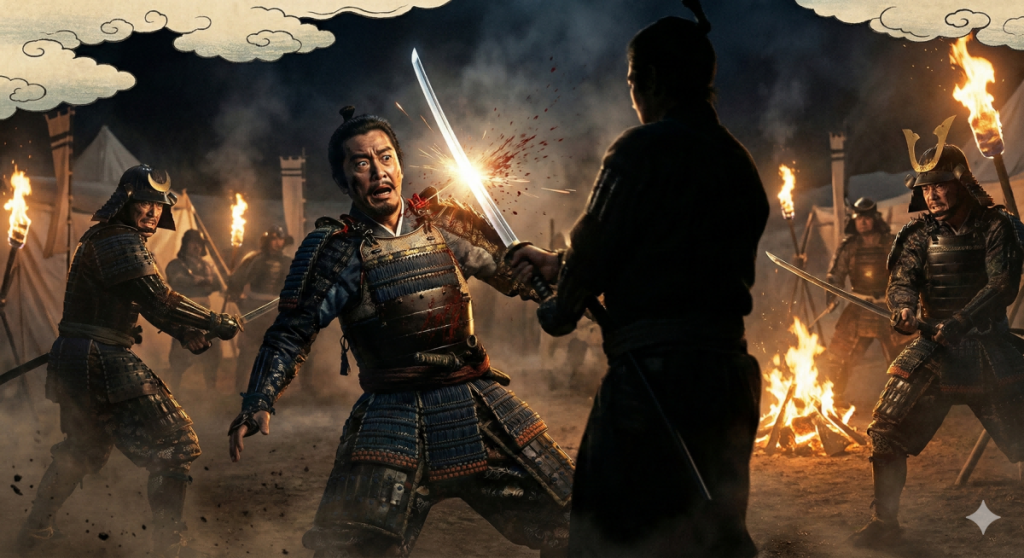
History often hangs by a thread—or in this case, the edge of a blade. One stroke from Abe Masatoyo’s sword delayed the unification of Japan by decades.
Jihad and the Twilight of Empires
As the empires of Asia were busy flexing their muscles or mending their cracks, a storm was brewing on the African continent. A wave of Jihad (“Holy War”) was sweeping across East Asia, pushing a thousand-year-old Christian kingdom to the very edge of the abyss.
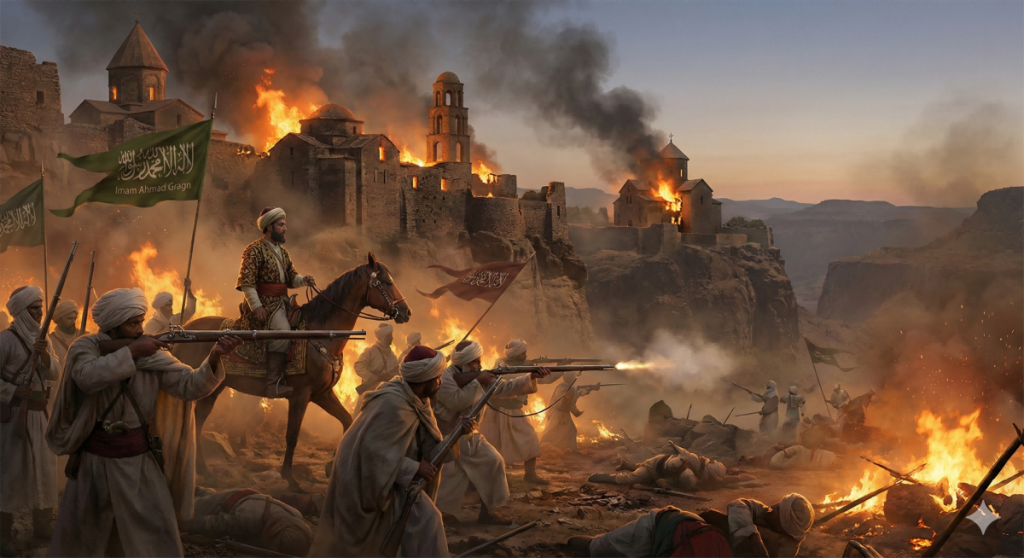
Ethiopia, an ancient empire that had embraced Christianity as far back as the 4th century, faced a brutal Jihad in 1535 led by Imam Ahmad ibn Ibrahim al-Ghazi of the Adal Sultanate—better known by his nickname, “Gragn” (The Left-Handed).
This time, “The Left-Handed” came prepared with a “physical buff” provided by the Ottoman Empire: a specialized corps of musketeers. Armed with this superior firepower, Gragn quickly overran the southern and central Ethiopian highlands, even penetrating the empire’s heartland in the Tigray region.
The Ethiopian Emperor, Dawit II, was hunted like a wild animal through the rugged mountains. The charred remains of countless ancient monasteries served as the grim footnotes to his life in exile. Driven to desperation, Dawit II had no choice but to dispatch envoys to distant Portugal, pleading for salvation.
The survival of an East African Christian kingdom no longer depended on local skirmishes, but on decisions made in the royal palaces of Lisbon and Istanbul, thousands of miles away.
Global geopolitics was quietly taking shape amidst the smoke and mirrors of war.
At that same moment, on the banks of the Niger River in West Africa, the Songhai Empire sat under the rule of Askia Mohammad Benkan. On the surface, the trade markets of Timbuktu were as bustling as ever. Islamic scholars continued to quietly transcribe ancient manuscripts, and the trans-Saharan gold trade continued to pour immense wealth into the imperial coffers.
But beneath the surface, the foundation was rotting. Benkan’s extravagant lifestyle and his heavy reliance on a growing class of palace eunuchs alienated traditional Islamic scholars and military generals alike. This was a magnificent castle built on sand, ready to topple at any moment.
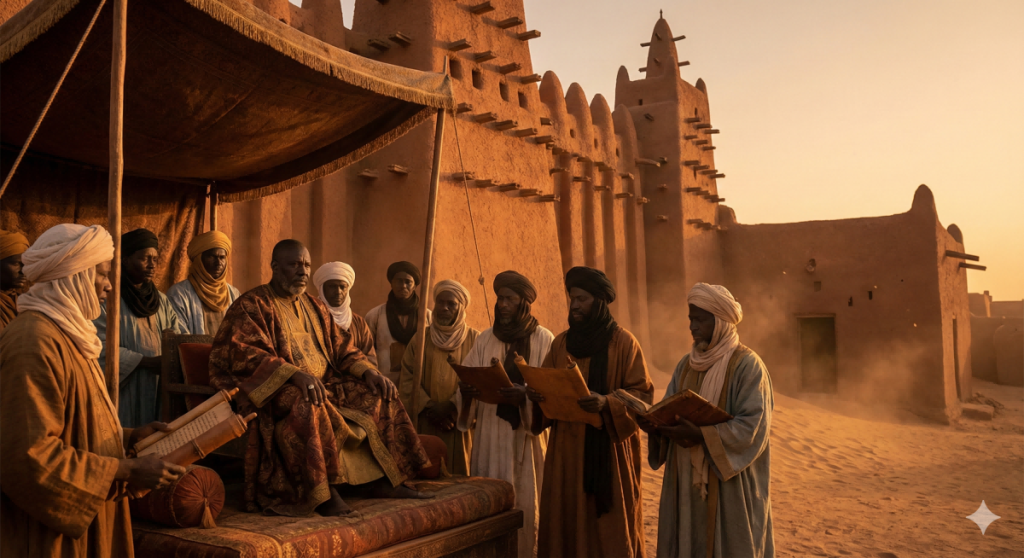
Undercurrents of Substance and Reason
Beyond the grand political narratives, 1535 saw subtle yet profound shifts in the realms of matter and science.
Paracelsus, the Renaissance’s wildest physician and alchemist, famously burned the medical texts of Galen—books that had been treated as the “Infallible Bible” of European medicine for over a millennium. A total rebel, he decried the incompetence of traditional medicine with scorched-earth rhetoric.
While wandering across Europe in 1535, he completed his magnum opus, Der grossen Wundartzney (The Great Surgery Book), and refined the core toxicological concept that “the dose makes the poison.” He championed the use of chemical treatments, such as mercury and sulfur, for diseases like syphilis—earning him the label of a “madman” from the medical establishment of his day.
Yet, it was this “madman” who laid the very foundations of modern pharmacology. It serves as a perfect testament to a recurring truth: sometimes, the people who change the world are the ones the world initially writes off as insane.
Meanwhile, through a more clandestine channel, a dark brown liquid was quietly reshaping the palates of the European aristocracy.

In 1528, Hernán Cortés brought cacao beans back to Spain; by 1530, a regular trade route had been established. By 1535, if you were to peer into the private chambers of a cathedral or palace in Madrid, Rome, or any major European city, you might find a bishop or a nobleman sipping a spiced, sweetened Aztec concoction from the New World—a drink once dismissed as “pagan bitter water.”
Today, products derived from cacao, such as coffee blends and chocolate, have become the world’s “sweet sin.” The irony of history lies right here: a bitter liquid once intertwined with blood and ritual has transformed into a modern global indulgence.
It brought more than just a stimulus for the taste buds; it became a subtle, lingering symbol of a world beginning to blend into one.
By the end of 1535, the old world was fracturing, and the new world was hardening
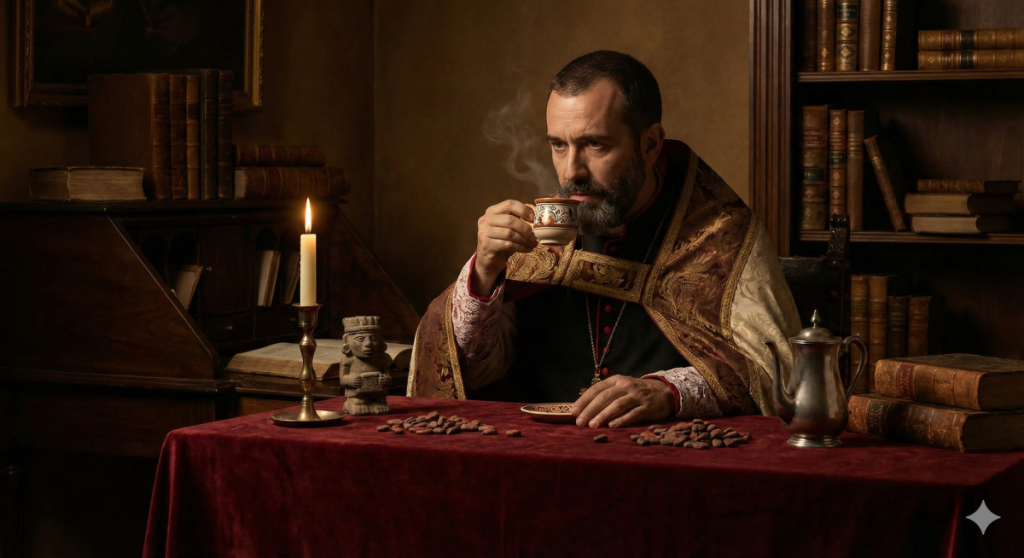
Boundaries were being drawn, “heretics” were being executed, and global trade was becoming a reality. Even our modern tastes were forming; by 1535, cacao (the source of chocolate) was being shipped regularly to Spain. What was once an “Aztec bitter water” was becoming a “sweet sin” for European elites, symbolizing a world that was becoming irrevocably interconnected.
Everything we live with today—nations, borders, the conflict between science and faith—found its roots in the heat and blood of 1535.